Tuesday, September 12, 2017

Higher Ed Affirmative Action To End? Sort Of.


By Professor Doom

     It really is amazing the level of scrutiny Trump gets. Every action, no matter how trivial, gets blown up and represented as negatively as possible. Even when he got a second scoop of ice cream, the media did what they could represent his getting a bit extra as yet another sign that he’s literally Hitler.

      Like any President, Trump has blood on his hands…it’s impossible to do that job without doing harm. That said, the media never mentions that, yes, occasionally, Trump does some good things.

      Affirmative action is a tough concept for a thinking man to agree with. The cognitive disconnect  necessary to accept “Things aren’t fair, so we need to make things less fair” by unfairly giving people with certain genitals/skin color advantages that have nothing to do with genitals/skin color is just too large for a normal person to possess and otherwise function normally in other aspects of life.

      Nevertheless, it’s how things work on most campuses. I’ve covered the racist and sexist hiring policies many times (see here, here, and here, as examples), and with the existence of such policies no longer in doubt, we need to go to the next level: we must consider why these policies are accepted.

      The answer is simple enough: administration is comfortable with racist and sexist hiring policies because they’ve learned to accept racist and sexist admission and scholarship policies. These highly questionable policies have done considerable harm in many ways, not least of which is harm to the kids the policies are supposed to help.

       And Trump is trying to put a stop to these evil policies:

Justice Dept. to Take On Affirmative Action in College Admissions


--sorry to link to a Left Wing Hate site, but we’ll get to that…


      Now, the paper naturally slants this as a bad thing:

“This is deeply disturbing,” she said. “It would be a dog whistle that could invite a lot of chaos and unnecessarily create hysteria among colleges and universities who may fear that the government may come down on them for their efforts to maintain diversity on their campuses.”


     Putting that “dog whistle” slur aside, it’s interesting that the paper doesn’t even question the assumption that “maintain diversity” is a good and necessary thing…it was never necessary at any other time in the planet. I assure the gentle reader that I was a minority as a white male mathematics graduate student, and it was common enough for me to be the only such in my classes (even when I was on the math department soccer team, I had to learn basic Mandarin so I could communicate with my teammates)….and it never once occurred to me that we needed programs to include more white males.

       But now it’s taken as a given that we need such policies. Well, not for white males, but I trust the reader knows what I mean here.

      In any event the paper gives no indication of an opposing point of view, so I need to shift to another site, one that allows comments. And, hey, look, there’s actual legitimate discussion of an opposing point of view:

Roger Clegg, president of the Center for Equal Opportunity, which opposes affirmative action, told the Times he welcomed the new campaign by the Justice Department. "The civil rights laws were deliberately written to protect everyone from discrimination, and it is frequently the case that not only are whites discriminated against now, but frequently Asian-Americans are as well,” he said.


     Much like Clegg, I’m against discrimination in any form. And, again, I had many Asian friends in graduate school. Even as they consistently demonstrated they were better students, it never occurred to me to set up a system to make me look good by locking them out.

      In an attempt to maintain balance, a pro-discrimination expert is cited, but, alas, all he can do is spew hatred:

Dan Losen, a lawyer who is director of the Center for Civil Rights Remedies at the University of California, Los Angeles, said that he found the Justice Department's action deeply distressing. "This is another example of how the administration is dismantling the Department of Justice, turning core constitutional protections upside down and the concept of remedying discrimination on its head," he said. "What do you expect from a president that makes openly bigoted remarks about Mexican-American judges, has boasted about assaulting women, has a history of engaging in racially discriminatory housing practices and is fighting to ban entrants to our country based on their religious background? Make no mistake, the Trump administration's positions are consistent with his bigoted statements and historical track record. 


      A point by point refutation of the assertions above can be done, but is beside the point: there’s nothing in it that says why the racism he favors is a good idea (although I have to laugh at raising the “historical” record of a guy in office not even close to a year).

     One of the neat things about the fake news revelations of late is how once one site runs the fake news, other sites play off it. So, it doesn’t matter if the original news is fake, you now have a dozen places all the saying the same thing, much like the grand Trump/Russia conspiracy theory.

      And thus I’m grateful that this site allows comments, as readers quickly point out an issue:

I saw this reported on CNN/HLN this morning as well, citing the times' article. At least CNN mentioned that it was the product of an unconfirmed leak.... In other words, another rumor.


Another reader provides even further clarification (though sadly, the rest of the comments degenerate into political irrelevancy):

….It came from the NY Times. That makes it suspect from the beginning. When will we learn to fact check Times stories before getting all upset about them? Turns out, of course, the story was false. It is to deal with an Asian American-related discrimination complaint filed during the Obama years.


     So, even if this new version is closer to the truth, it’s still a start for fixing this everyday injustice, just as Rosa Parks at least started the conversation we needed to have then.

     Instead of being moved to the back of the admissions line, an Asian-American is standing up and saying what we’re doing to our kids regarding admissions at our few good schools is wrong.

      Now, I grant that at best it only looks like admissions will be targeted here, but once this is addressed then perhaps we can indeed address the sexist and racist hiring policies that are now accepted at many of our institutions of higher education.


Saturday, September 9, 2017

The Evil Teacher Whisperers


By Professor Doom

     The “Horse Whisperer” and “Dog Whisperer” are amazing people, and I encourage the gentle reader to watch at least a few of their shows, as they demonstrate both the individual capability of those people, and the ability of humanity to handle and control animals in ways that you simply do not see in the other direction.

     On the other hand, a recent article on “Teacher Whisperers” demonstrates the incredible evil going on in higher education today:

Student Underperforms. Student Fails. Administration Informs. Student Prevails.


     The subtitle sounds good, right? The student prevails, after all, but that subtitle is pretty misleading. Yes, the administration “informs,” but it’s with all the menace and threat as anything gently said by Emperor Palpatine.

     What’s interesting about this article is the evil of the administration is just glossed over, as though it weren’t the heart of the problem. Let’s get to the story:

One of my advisees, a graduating senior whom I will refer to as Johnny, earned a failing grade in a course he needed in order to graduate.  At the beginning of May I received a phone call from a dean letting me know that Johnny would be coming in to discuss possible paths to graduating with his cohort. I met with him to discuss his options, and after a collaborative exhausting of the possibilities during which multiple deans were having conversations with multiple faculty and family members in what can only be described as a goat rodeo, I was nominated to inform Johnny that he would have to take a summer course. In other words, he would not be graduating with his cohort. I had a gnawing feeling in my gut that this would not go over well, but someone needed to woman up and speak truth to a failing student.


      I should note that the author doesn’t cast aspersions on administrative evil here, and the author uses her real name in the article.

      The two facts in the previous sentence are intimately related, I promise you.

     In any event, I too have had many “he’s a graduating senior, so give him a break” whispers from admin, and these incidents highlight a huge paradox in higher education that nobody ever seems to wonder about:

Fact 1: The average college grade is A-. Just about everybody does well in class.

Fact 2: On-time graduation rates are ridiculously bad, with 0.6% considered successful. Even on an infinite timeline, 25% graduation is still considered so good that Poo Bahs and other admin get huge bonuses for it.


      Grades are great, but few graduate. I want to again emphasize: I’m not brilliant by any stretch of the imagination. How is it that I see a paradox regarding those two facts, but I’ve yet to see any legitimate discussion of it?

      Am I truly alone in seeing a paradox in everyone doing well in classes, but very few doing well in enough classes to graduate? It’s like saying everyone has exactly $45.03 in their pocket, but almost nobody can pay a bill for $20.01 with exact change.

     We have many thousands of Fiefdoms for Undergraduate Success in this country, filled with Ph.D.-holding administrators with degrees in Getting Kids to Get Degrees, but none of them have figured out there’s a problem here. Hmm, it’s rather like schools with Diversity Vice-Presidents tend to have more diversity related riots.

     Perhaps I’ll talk about why this paradox exists later, but for now, the point is when there’s a graduating senior, a student with a real chance of actually graduating, admin is pretty motivated to get it done.

     So, if it’s just one course causing a problem, you better believe as faculty you’re going to have multiple deans on your case about giving that student a break, because many schools actually have a deans/graduating student ratio greater than 1.

     Back to the story, which is all too common in higher ed:

Johnny subsequently exploded into a diatribe of electronic threats, including a promise to sue and a personal threat to me. The threats, although scary in today’s gun toting society and a little creepy besides, are not what haunt me. What haunts me still is what happened afterward. My department chair shielded me from the fallout, so I heard the solution after the fact.  Spoiler alert: Johnny graduated along with his cohort, just as he had demanded to do.


      Again, I’ve personally seen the like. I honestly can’t tell you how many times I’ve stood at graduation and seen students I know did not pass the courses required, nevertheless be handed a degree by admin.

       I really want to point out, however, that this student threatened his professor, and admin rewarded the student. Again, I don’t understand, it should be very obvious that admin should be siding with the professor here. I know full well if I ever threatened admin, I’d be fired, and certainly not rewarded. Why don’t faculty get this rudimentary level of respect?

      The author just glosses over this detail, but the gentle reader needs to understand: word gets around. Other students have now learned that you can graduate by making threats.

      It’s a bad precedent, and further emphasizes how completely bogus those Ph.D.s in Administration are. They really should have learned the basics, here.

     I grant this sort of administrative abuse/idiocy is now quite common in higher education, but I don’t think the response should be to gloss over it. The author glosses over it, but does ask a few questions:

When does it become necessary to accommodate lawn-mower parents and teacher-whispering administrators?  When did it even become possible for parents and administrators to influence course outcomes? Are educators not hired to teach and assess students? When students and their families demand to speak to a supervisor, how is it feasible that they would be given the impression that deans and other administrators have any role at all in course outcomes? 


      These are all good questions, but miss the point by a wide margin. There is only one question here that needs asking:

If admin can just hand out grades, why should we even have faculty on campus?


     I can answer the question, but I cannot do so without questioning the legitimacy of what’s going on in higher education.

      I reiterate that the conditional of the question is valid, I’ve seen it with my own eyes enough times. On many campuses, the only reason faculty still exist is because accreditation demands it rather specifically. That said, most faculty are meat puppets, only able to do exactly what admin wants, no more. If accreditation allowed it, faculty would be absent from campus in short order since paying them cuts into administrative bonuses.

       I’m still very concerned about how the student can threaten faculty without repercussion. It’s only a matter of time before students at this campus realize they can start threatening admin as well (we’re already seeing this at other campuses, after all).

       All the shenanigans in higher education causes another question to come up often: why are degrees so expensive and viewed as valuable if they represent so little?

       I’m not sure I like my answer to that question, either, but I assure the gentle reader that the student loan scam has much to do with it.


Wednesday, September 6, 2017

Gold, Dollars, Stocks…and Bitcoin.


By Professor Doom

     I was a professional stockbroker and investment banker1 before I went into academia, and it is my blog, and so I feel entitled to talk a bit about the insanity in our monetary system…there’s much to say, so much that I’ll be rambling a bit trying to just hit the highlights.

     I’ve mentioned before that the current Fed experiment of reducing interest rates to nothing and simply handing over huge sums of money to the banks has been wreaking havoc on our financial system, and not just by eventually destroying every pension fund in existence.

     The “zero interest rate” experiment has also done considerable harm to the average investor with only basic skills and (if he’s sane) minimal tolerance for risk…how can he make money, or even preserve what he has? Reducing interest rates to nothing means that the classic investment for a low-risk investor, bonds, is stupid. Most bonds are paying far below the actual rate of inflation human beings endure right now (and now there are negative interest rate bonds, obviously paying less than the Official Government rate of inflation). Buying bonds is a definite losing proposition.

      Most people have responded to the lower bond interest rates by pouring money into risky stocks…but it’s a sucker’s game. Although the mainstream media screams how great the stock market is doing, there are thousands of stocks out there…and most all the gains can be attributed to a very few stocks. Amazon is pretty much it, most every other stock is a loser.

      Besides, stocks are ridiculously manipulated by our government; it’s impossible to tell just how much of the stock market is being propped up by the government’s “plunge protection team” and outright buying of stocks by the Fed (yes, it’s illegal for it to do so, but it’s a simple matter for the Fed to lend to foreign bank friends, with the understanding that the money will be spent on stocks…we should ask questions about whether this is a good idea, at some point). Nothing stops foreign governments from just printing their own money to buy stocks, either.

     Seriously, a hurricane devastated Houston…and the Dow Jones didn’t budge. The US just took 200 billion dollars’ worth of damage to a hub of major economic activity, and that’s not reflected in stocks? Obviously, something is very wrong here. If you’re not an insider, you’ve no business in a market this artificial.

      A conservative investor has little option but to stay on the sidelines…and thus keep his cash as what we call “money,” which I’m going to crudely refer to as anything that can be quickly enough converted to dollars.

     Plato defined money thousands of years ago, but great as he was, he used a weasel word in his definition of money, when he said money was a “store of value.” What’s value? It’s an important detail, but let’s pretend we value money in whatever form. I’m only going to mention stocks, bonds, cash, gold, and Bitcoin here because there are all pretty much money—you can quickly assign a dollar value to them and within at least a week, get that value. Real estate, for example, doesn’t really count because you might get an appraisal, but it’ll still take weeks or months to find a buyer, with no guarantee he’ll offer the supposed value.

      So, staying out of stocks and bonds, what kind of money should you have?

      An investor could keep his money as dollars, but there’s a problem here beyond simply losing value to inflation. Our government steals money from its citizens now, and steals more than actual (non-Government) thieves. A cop finds you with a wad of cash, he can just take it. This sort of “legal system” is probably a bad idea and is a big factor in why government is taking more than thieves (and I’m not even considering taxation here)…we should probably ask questions about that at some point, too.

      So actual physical cash is a bad idea. Put it in the bank? Well, that has risks as well, as investors who read the world news know. Either way, fiat dollars as a store of value is a problem; we all know that government’s “1.5% inflation” is bull$#@t, there’s not a single expense of mine that isn’t up over 60% in the last decade (if not more), and my friends in other parts of the country say it’s about the same. Cash is better than negative interest rate bonds but still an obviously bad investment.

    So, what other money is there?

    Gold seems like a good idea but has some serious problems right now. Again, “value” is a problem since ultimately gold’s value is a matter of opinion (an opinion humans have held for thousands of years, to be sure, but still just an opinion), as opposed to value our dollars have due to the many guns our government has. The situation for gold is worse than just opinion, however.

      Much like our markets, gold is heavily manipulated by our government. Gold is traded as a commodity, but with one weird quirk. See, with most commodities, you can go to the market and buy “paper” versions of the commodity via a contract. For example, you can buy 20 tons of potatoes, on paper, to be delivered 3 months from now. You put some money down, and pay the rest at the end of the contract, if you want the physical commodity.

      These types of transactions are called options contracts (I’m simplifying greatly here, bear with me). After a specified period of time, you can trade in the contract for the actual commodity (in which case you have to write a huge check, and better have a place to store what you just bought), or just take a check for the difference between the current price of the commodity and whatever you agreed to pay months earlier (and, if the current price is lower than it was before, you might get nothing, so these types of contracts can be very risky).

     Now, these contracts make sense for big business. If you’re, say, McDonalds, you might want 20 tons of potatoes, and you might want to know what you’ll be paying for them, when the crops come in. So, for the privilege of knowing what price you’ll pay at worst, you buy a contract, and use it if the price of potatoes is higher than you thought it might be. Speculators can buy them, too, making (or far more likely losing) fortunes in a matter of days, or even seconds. Unless you’re Hillary Clinton, of course. 
   
      Anyway, at the end of the contract, McDonald’s can write a big check and quite literally get a trainload of potatoes.

     Gold is different. Although you can buy it as a commodity, there’s a special quirk. For some reason, you legally cannot get the gold you’re paying for. At the end of the contract, you can write a huge check and you’ll get….a huge check. You trade paper for paper. It’s all paper, and the end result is, if you have the ability to print an infinite amount of dollars, you can sell an infinite amount of paper gold, completely controlling the price. No amount of buying will cause the “value” to rise relative to dollars, and if McDonald’s ran the risk of only getting a check instead of actual potatoes, McDonald’s would ask for a contract where it can get the potatoes; there’s no similar option for gold, all you can get is paper.

      Investment firms go nuts trying to guess what gold is going to do, because the gold market is fake, and gold does not at this time qualify as an investment.

      So, it doesn’t matter that China/Russia/India is buying massive amounts of physical gold, the price only moves if the government allows it, because it can just sell paper gold all day long. China’s opened a physical gold commodities exchange, so, someday, this ‘paper gold’ issue will collapse and there’ll be a whole bunch of people holding slips of paper but not actual gold. The current ratio of imaginary paper gold to actual physical gold being traded is around 200 to 1, every ounce of physical gold could have 200 people with a piece a paper saying they own it, to give an idea what a mess it will be when that day comes. Whether that day is next week, or in 500 years, my crystal ball is unclear.

      Gold, stocks, bonds, dollars are all forms of money, and all are under the absolute control of the government, making them all pretty risky investments at this point in time, with no way to know the “real value” (whatever that means) of these investments.

     Now comes the new kid on the block: Bitcoin.

     Bitcoin used to be the primary money of the free black free black market, you could use it to buy a hit of drugs…and it wasn’t worth much more than that for years (say, $10 or so, just to give it a number). Then, the guy who was running the biggest free black market, “Dread Pirate Roberts,” was arrested, four years ago.

      Government naturally moved to steal his money, but to do so, Roberts would have to give them the passwords to his Bitcoin wallet. “The Fifth Amendment,” said Roberts, who rightly noted that giving the passwords might incriminate himself. He got to keep his money.

     Across the world there was an important revelation:

 Bitcoin is money not controlled by government.

     This is what began the big run on Bitcoin, to $100, to $300, to $1000, to now over $4,000 and even breaking $5,000 recently. I don’t want to go into detail as to what, exactly, Bitcoin is, but it’s amazing that these non-physical items are now (as of this writing, the dollar values may change dramatically up or down at any time) are now worth over three times the price of an ounce of gold. That’s a pretty good indication how fake the gold market is: imaginary coins are worth more.

      Incidentally, for the crime of running a website selling things the government doesn't like and using Bitcoin as money, where no customer felt defrauded or injured, the guy got a sentence of Life Without Parole. Considering rapists, pedophiles, murderers and billion-dollar heisters like Madoff didn't get such a sentence, we probably should ask some questions about the real "crime" here.

       Now, people are buying Bitcoin, much like countries are buying gold. There’s an important difference:

There is no paper Bitcoin market.


     The above means that government cannot interfere with the Bitcoin price; every purchase of a Bitcoin is an actual purchase of a Bitcoin, so normal economic rules apply regarding supply and demand. It’s a huge, huge, difference.

     The issue isn’t (physical) gold is worth less than Bitcoin…the issue is Bitcoin isn’t controlled by any government. You can buy things with it, not just drugs. The IRS considers Bitcoin a capital investment (much like, say, stocks), but at some point there will be major transactions completely outside of the dollar system (“Trade me your house for 100 Bitcoins”) and we’ll get to see the courts decide if the government can set dollar values on everything even more directly than they do now.

       Of course, the government could pass a law saying Bitcoin cannot be used for transactions, but some countries, crushed by the Fiat System (hi Japan!) have actually legitimized Bitcoin as a currency. Considering Bitcoin’s roots in the free black market, government attempts to ban its use probably won’t be particularly successful, although many attempts are in the works, potentially destroying Bitcoin overnight. I doubt it’ll happen, but it’s a legitimate risk. Similarly, I doubt a solar storm will fry all the electronics on the planet, also annihilating Bitcoin overnight…but it could also happen.

      So, sure, Bitcoin is risky in today’s incredibly manipulated financial environment. Everything’s risky. But if you want to know why Bitcoin is skyrocketing, why everyone knowledgeable about what’s going on in the world today is interested in Bitcoin, I’ll put the important detail down again:

      Bitcoin is money not controlled by government.


1.      I feel like I’m putting on airs by saying this, but it was my job title (like most titles, it’s overblown).

Sunday, September 3, 2017

College Graduate IQ In Freefall


By Professor Doom

     One of the weird things about higher education is how the smart people are fleeing it. Now, that’s at the grad school level, and I noticed it seemed to start just about the time I was done with graduate school: my most talented friends were getting their Ph.D.s, seeing what higher education had to offer, and decided an academic career was a terrible idea. They headed to the “real world” never to do anything for education or research. It takes brilliance and character to conceive “the four years spent getting a Ph.D. was a waste, and I need to do something different,” and walk away from all that hard work. I acknowledge my error here.

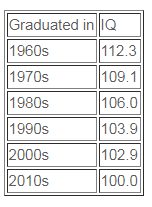
     That’s my anecdotal evidence regarding the really smart people (although I’m not alone in seeing it), but what of the rank and file college student? What’s been happening there? A helpful chart answers the question:


      It may only seem like a few points every decade, but in terms of statistics, there’s much to be said about this chart.

     First, a minor digression.

     In the olden days, companies would give “aptitude tests” to people they might possibly hire. This was a perfectly reasonable thing to do, as the company would invest considerable resources into training an employee. Thus they were quite motivated to make sure the employee was “apt,” able to learn the skills the company needs.

       There were complaints that these aptitude tests were RACIST, and so companies that used them opened themselves up to huge lawsuits from a government with infinitely deep pockets to pay for the lawyers to file such lawsuits. Companies not wanting to fight such an impossible battle got rid of the tests.

       The government forced aptitude tests to disappear but companies still wanted some way to tell if a person would be able to learn the work they were going to train for. What to do? Well, the government generously allowed companies to restrict hiring to “college graduates,” i.e., hiring to only people who had a government-granted certification of aptness.

      Say, does anyone else see a conflict of interest in government forcing people to not use anything but government to determine something? Let’s see how the Law of Unintended Consequences works out here.

I majored in Computer Science at college. I programmed every day. I went to graduate school for computer science. I programmed every day.
My first job: I was a computer programmer at HBO.
I was so bad that they had to send me to REMEDIAL school for two months to learn enough about computer programming to be as good as their WORST programmer.


     Thus it came to pass that having a college degree became a “gateway” into the middle class, unlike in the past where simple talent and skills were enough. The funny thing is, a college degree as it is today doesn’t really help companies much. Even if you have a very specific skills degree like “Computer Programming,” if a company hires you, you’ll likely still have months of training in how to actually program in a way that the company will find useful. The collegiate version of programming focuses on computer languages and skills which went obsolete a decade or more ago (because it takes at least 10 years to set up a college degree program, and anyone who deals with computers knows a decade may as well be 1,000 years for computers…).

      While I blame the student loan scam for the immense growth in the size of our campuses, the loans just pay for the degrees…the demand comes because many companies have no other way to restrict their hires beyond requiring a college degree, and the kids are told this nearly every day in school.

     Now, let’s look at that chart more carefully, by first considering the variation from each decade, for the first four decades:

60s to 70s
-3.2
70s to 80s
-3.1
80s to 90s
-2.1
90s to 2000s
-1

     You can dispute the validity of intelligence tests in general but you can’t dispute the trend in the above. Certainly you expect to see variation from decade to decade, but when the variation is always in one direction (down), you must suspect it’s not random.

      It may look like there’s a bit of convergence, namely that the drop is going to zero, but this is just how probability works—the proportion of people with IQ between, say 109.1 and 112.2 is roughly the same as the proportion between 102.9 and 103.9 even if the latter is a smaller range of numbers.

      More simply said, in terms of proportion, every decade we lose about same amount of intelligence in our college graduates. Ok, that still might not be simple enough, but the gist should be clear to the layman: a college degree means way less than it used to in terms of intelligence.

       Now, let’s consider the most recent decade, where the drop in IQ is now 2.9. This is a relatively huge drop compared to the previous decade, about 4 times as much in terms of proportion.

       In short, we’ve gone from a disturbing but relatively constant drop in the IQ of our college graduates to a very sharp drop.

      Today, in terms of intelligence, a college graduate now is simply average. How useful is such a government certification? The price of the degree has gone up dramatically while the usefulness of that degree to employers has dropped even more so, to effectively zero. You could just get a random guy off the street and expect average intelligence, after all.

      I’m saddened by the loss of our most intelligent people in graduate school: we’re losing our best and brightest because they’re smart enough to see quickly that higher education is a dying system that would merely exploit them…this does not bode well for humanity, as this will impact the advancement of human knowledge.

     Alas, the issues are even bigger than what’s happened in graduate school:

To say we're well into the territory of diminishing returns is to understate the problem--we're past the point of negative returns. Most Americans in college today are not benefiting from being there. They're foregoing work to accrue debt for degrees that, if they increase earning power at all, do so only marginally and they're picking up an unhelpful sense of entitlement in the process.

     While there is truth in the above, I’m more concerned by the suddenly accelerating drop in IQ of our college graduates in the last decade. At this pace, it’s reasonable to conjecture that very soon a college graduate will have below average intelligence. It’ll be perfectly clear then that the smart people aren’t just leaving graduate school, they’re fleeing college in general.

     It’s a big problem for humanity that our scholars will no longer represent the smartest people humanity has to offer. It’s a bigger problem for humans that having a college degree will soon mean that you’re of below average intelligence.

     If the trend continues, and all evidence says it will, by next decade having a college degree will be telling your employer: “I was stupid enough to get a degree and you should not hire me.”

     Once again, we see the Law of Unintended Consequences in action, as turning higher education into a government program to determine who is qualified to have a good job will instead determine who is unqualified.

      That our kids are going in debt for a certification of incompetence is insult to the injury. End the student loan scam.


Thursday, August 31, 2017

Claremont College Suspends Rioters!


By Professor Doom

     Across the country, our students have been trained to believe that it’s fine to use violence to prevent someone from speaking. While years ago, a riot to prevent a speaker was major news, now they’re so common that even local newspapers hardly consider it worth covering.

      The reason we have these riots is our schools are populated with, well, non-students. The reason our schools are populated with non-students is because the administration of those schools don’t care: they’re paid based on butts-in-seats, and the butts need not even be in seats, merely registered as students.

      A very basic idea to stop the riots is to get rid of the rioters, but, across the country, admin just doesn’t have the spine/integrity/intelligence to do the right thing.

      Back in April, Heather McDonald tried to give a speech at Claremont College, and protesters attempted to prevent people from hearing what she had to say. This was not simply holding signs, they were physically blocking the doors and access to the venue.

     Other schools have sought to placate the protesters, giving them boons for their thuggish behavior. Claremont wisely decided upon a different tactic:


      To be fair, only 7 students (of approximately 170 rioters) received disciplinary action based on their inappropriate behavior but….YES!

The College followed a full, fair, and impartial student conduct process before the determination of findings, sanctions, and the resolution of appeals. Efforts to politicize and interfere with this process had no influence on timing or decisions. Students had an opportunity to be heard, pose questions, ask for further investigation, and raise objections throughout the process. The independent panel of three (one panelist each from the faculty, staff, and student body) determined their findings of responsibility on a preponderance of video and photographic evidence and a limited amount of witness testimony. Sanctions were based on the nature and degree of leadership in the blockade, the acknowledgment and acceptance of responsibility, and other factors.
--emphasis added.


        As per the emphasis above, the students here were allowed to speak—I wonder how many refused to speak, since such a refusal would demonstrate they honestly believe people should not be allowed to say what they will. I really wish I could learn this about these students, because knowing these students are intellectually honest about their beliefs would lead me to reconsider the possibility they are wrongheaded. Too bad, and ultimately we should pay attention to the people running the place anyway.

     The people running our schools call themselves “leaders” but they really should be stewards. A steward protects and cares for the school and that’s why I cheer the actions of the self-proclaimed leadership at McKenna College. By showing the student base there that violent opposition to opposing ideas will not be tolerated, the administration is taking an action that will help to preserve the school’s integrity, and thus the school.

      Compare to Mizzou, which has a policy of endless appeasement of rioters. Instead of teaching rioters that such behavior will be punished, the rioters instead learned that violence and threats of violence will get rewards. The end result of Mizzou’s leadership? Their student base is dropping, as nobody in their right mind wants to go to a school notorious for riots and with a reputation for anything but education. They’re closing their dorms for lack of students, and may well close the school in a few years if the appeasement continues. Mizzou has leaders, not stewards, so I’m sure they’ll get massive golden parachutes for their leadership when the school closes.

     Back to Claremont. Only 5 students were removed from campus for their anti-civilization behavior, and then only suspensions; seeing as nobody was physically hurt, I’m not about to argue with the fairly light penalties. It’s at least something, and will do far more for education at that school than additional appeasement.

      The Left-wing Hate media naturally will not respect Claremont’s ruling:

The Atlantic's Conor Friedersdorf complained that the school's punishment for the student protesters was “overly harsh.”

He quoted Nana Gyamfi, a human rights lawyer based in Los Angeles, who said Black Lives Matter was “justified” for shutting down conservative events because they felt their lives were “threatened.”

An example from Gyamfi was that once in 2015, an “anonymous figure” posted a death threat on a Google document that was created by an alumnus of the school to promote racial diversity.

Friedersdorf said he wouldn't go so far as to describe Mac Donald as a threat to students' safety, but he still thinks the college should have promoted a culture of free and open debate instead of clamping down on the students without proper warning.


     Wait, what? You need to warn students that they’ll be punished for engaging in violence and threatening behavior? I’m sorry, I know they’re still sort-of kids, but a year’s suspension (the heaviest sentence, on three of the 170 students involved) won’t end their lives, and might give them a chance to re-dedicate themselves to education…instead of more violence.

      The Atlantic ran a full on hit piece against Claremont, trying to make it look like admin was coming down on the wrong people. It’s an embarrassingly bad representation of events at Claremont; I won’t even dignify the piece with clarifications. The gentle reader should note carefully: there’s not a single comment regarding this piece of “journalism.” From this we can gather how many readers take The Atlantic’s coverage seriously. Much like with CNN, many Left-wing Hate media sites have lost considerable readership due to being caught being unarguably wildly dishonest on so many occasions.

      In any event, we now have something important: Claremont is taking a completely different response to the riots. Now we just have to sit back and see if the riots continue. If they do, then the “leaders” who continue their policies of appeasement will at least have some defense for their spineless behavior.

      This is exactly why we need to allow opposing points of view. If all our institutions all had no choice but to think the same way about everything, we wouldn’t have the opportunity to see if maybe there’s another solution to rioting besides appeasement followed by further appeasement.

       I suspect the riots will end at Claremont, and then, I hope, I won’t be so alone in holding the appeasers in such contempt.